 Eovara Pets
Bernedoodle: The Fluffy Family Dog That Isn't as Low-Maintenance as It Looks
Learn what it's really like to own a Bernedoodle, including size, personality, exercise, grooming, diet, health problems, lifespan, and ideal owners.
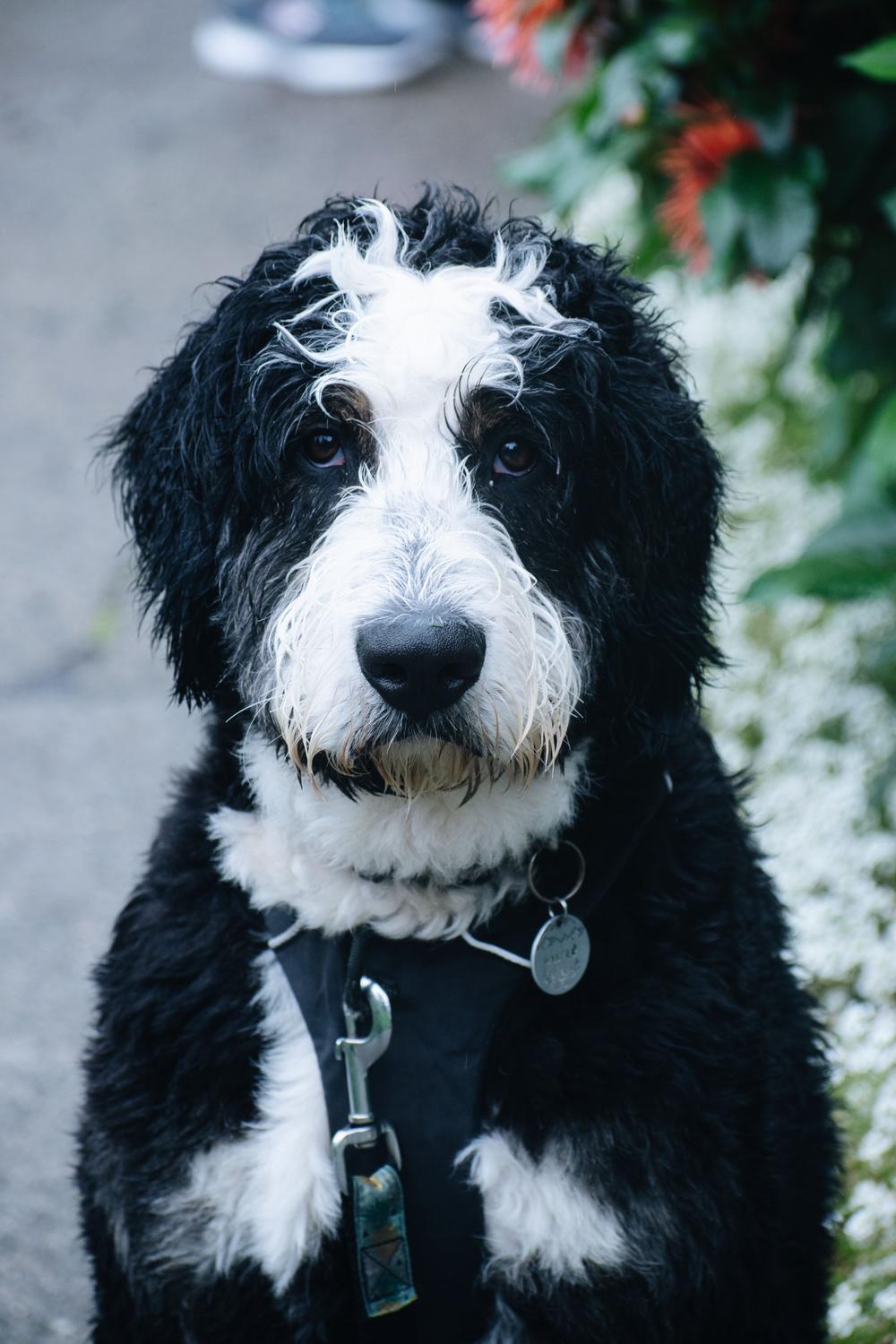
A Bernedoodle is a cross between a Bernese Mountain Dog and a Poodle.
At first glance, the appeal is obvious: the gentle personality and striking tri-color appearance of the Bernese Mountain Dog combined with the intelligence and potentially lower-shedding coat of the Poodle.
But there is an important catch.
A Bernedoodle is not a predictable “best of both breeds” package.
Because it is a crossbreed, individual dogs can vary considerably in size, coat texture, shedding, energy level, and temperament. Even two puppies from the same litter can end up looking and behaving quite differently.
And while Bernedoodles are often marketed as “hypoallergenic,” that claim needs to be treated carefully. No dog is completely hypoallergenic, and some Bernedoodles can still shed or trigger allergies, according to PetMD.
So the real question isn’t simply:
“Are Bernedoodles cute?”
It is:
“Can I handle a large, intelligent, social dog whose coat may require a surprising amount of maintenance?”
If you’re weighing a Bernedoodle against other family-friendly breeds, our Pomsky guide covers another increasingly popular—but very different—designer mix, and our Dachshund guide looks at a much smaller, more independent breed on the opposite end of the spectrum.
1. Bernedoodle Breed Overview
What is a Bernedoodle?
A Bernedoodle is a designer cross between:
- Bernese Mountain Dog
- Poodle
The Poodle parent can be Standard, Miniature, or, in some breeding programs, smaller varieties.
This produces several general size categories.
| Type | Typical Adult Weight | Approx. Lifespan |
|---|---|---|
| Standard Bernedoodle | 61–100 lb | 12–15 years |
| Mini Bernedoodle | 20–45 lb | 14–16 years |
| Toy Bernedoodle | Under 20 lb | Up to ~18 years |
These figures come from PetMD and should be treated as approximate rather than guarantees. Size and lifespan can vary considerably depending on the parents and individual dog.
The Standard Bernedoodle is a BIG dog
This is easy to underestimate because puppy photos dominate social media.
A full-grown Standard Bernedoodle can weigh 60–100 pounds and stand up to around 29 inches tall.
That means you’re not getting a medium-sized teddy bear.
You’re potentially getting a 100-pound dog that still thinks it belongs on your lap.
What does F1, F1b and F2 Bernedoodle mean?
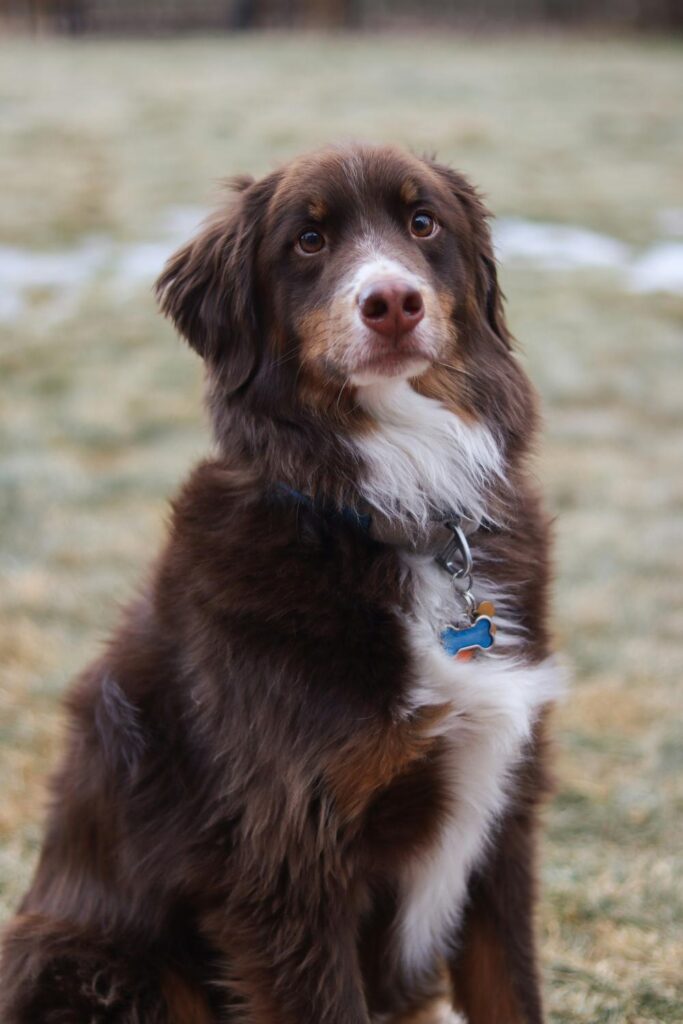
Brown and white dog sitting in a grassy field and looking at the camera.
You will often see Bernedoodles advertised as:
- F1 Bernedoodle
- F1b Bernedoodle
- F2 Bernedoodle
These labels describe the dog’s lineage.
F1 Bernedoodle — Bernese Mountain Dog × Poodle. This is the simplest Bernedoodle cross.
F1b Bernedoodle — Bernedoodle × Poodle. The puppy is approximately 75% Poodle and 25% Bernese Mountain Dog. This generation is often sought by people who want a curlier, lower-shedding coat, but individual results still vary.
F2 Bernedoodle — Bernedoodle × Bernedoodle. This can produce considerable variation in coat and appearance.
The important takeaway: generation labels can tell you about ancestry, but they don’t guarantee temperament, coat type, or allergy-friendliness.
2. Bernedoodle Personality
What is a Bernedoodle’s temperament like?
Bernedoodles are generally described as:
- Affectionate
- Playful
- Intelligent
- Social
- Gentle
- People-oriented
- Sometimes goofy
- Sometimes stubborn
The combination makes sense.
Bernese Mountain Dogs are known for their gentle, affectionate temperament, while Poodles are highly intelligent and trainable. Bernedoodles often inherit qualities from both.
But there is another trait prospective owners should pay attention to:
They often want to be with you.
Bernedoodles tend to enjoy family interaction rather than simply being left in the backyard.
Their Bernese parent in particular has a reputation for forming strong bonds with its family, and some Bernese Mountain Dogs can struggle with being left alone.
So if you’re looking for a dog that happily spends most of the day by itself, this may not be the ideal match.
Are Bernedoodles good family dogs?
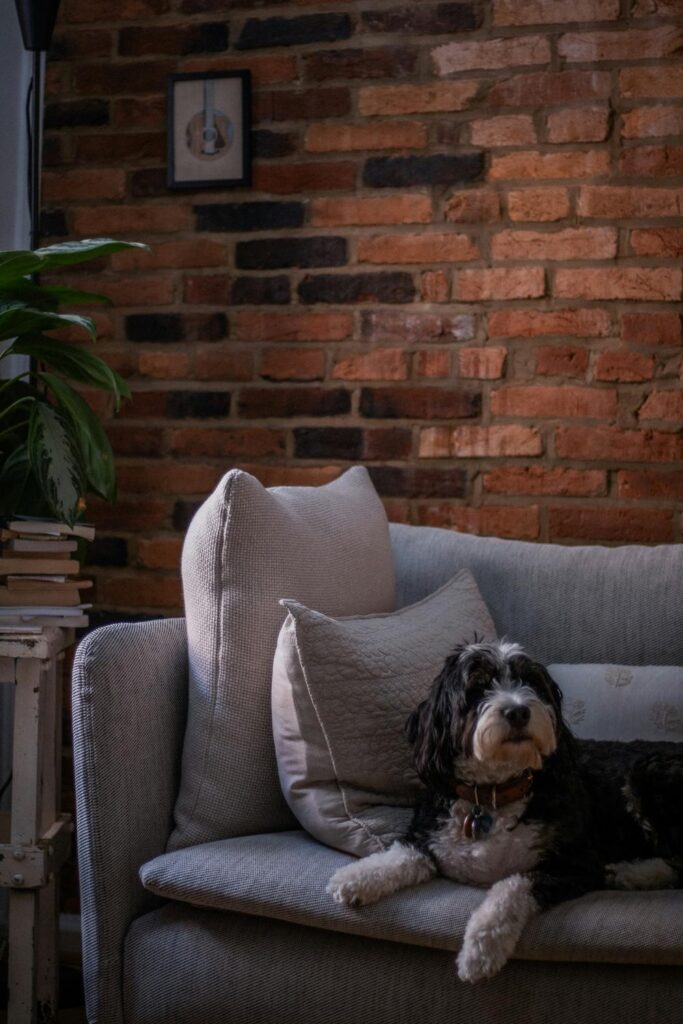
Generally, yes.
A properly socialized Bernedoodle can be an excellent family companion.
They can enjoy:
- Children
- Other dogs
- Family activities
- Outdoor adventures
- Training games
- Relaxing at home
PetMD describes Bernedoodles as generally gentle and friendly with children, other dogs, and smaller pets such as cats.
Of course, individual temperament varies, and children should always be supervised around dogs.
One thing parents sometimes underestimate
A large Bernedoodle doesn’t have to be aggressive to accidentally knock over a child.
A playful 70–90-pound dog can cause plenty of chaos simply by running around the house.
Training “four paws on the floor” and polite leash behavior is therefore more than a convenience—it’s basic household management.
3. Bernedoodle Daily Care
How much exercise does a Bernedoodle need?
Bernedoodles are generally active dogs, but their exercise requirements vary with size, age, coat, health, and individual temperament.
A practical adult routine could include:
- Two daily walks
- Interactive play
- Training sessions
- Sniffing/exploration
- Puzzle toys
- Hiking
- Swimming
- Agility or other dog sports
PetMD specifically recommends at least two walks per day, along with mental stimulation such as puzzle toys and snuffle mats.
Don’t make the mistake of thinking walking is enough
A Poodle’s intelligence can make Bernedoodles surprisingly demanding mentally.
A dog that gets plenty of physical exercise but spends the rest of the day bored can still develop unwanted behaviors.
Try combining physical exercise, training, and problem solving. For example:
30-minute walk → 10-minute obedience session → food puzzle → rest
This can be much more effective than simply trying to exhaust the dog with increasingly long walks.
4. What Should a Bernedoodle Eat?
There is no special “Bernedoodle food” that every dog needs.
A complete and balanced diet appropriate for the dog’s age, size, activity level, body condition, and health status is generally the right starting point.
PetMD recommends nutritionally complete food meeting AAFCO standards and notes that Standard Bernedoodle puppies should receive food formulated for large-breed puppies.
Standard Bernedoodle puppies deserve extra attention
Large dogs shouldn’t simply be allowed to grow as quickly as possible.
Rapid growth and excess weight can put additional stress on developing joints. The Bernese Mountain Dog itself is susceptible to hip and elbow dysplasia, making controlled growth and healthy body weight especially important.
How often should a Bernedoodle eat?
A practical schedule is:
- Puppies: 3–4 meals per day
- Adults: usually 2 meals per day
For Standard Bernedoodles, splitting food into multiple meals rather than feeding one huge meal can also be useful because large, deep-chested dogs are at risk of gastric dilatation-volvulus (GDV/bloat).
If your dog eats extremely quickly, a slow feeder may also help.
5. Bernedoodle Grooming: The Part Instagram Doesn’t Show
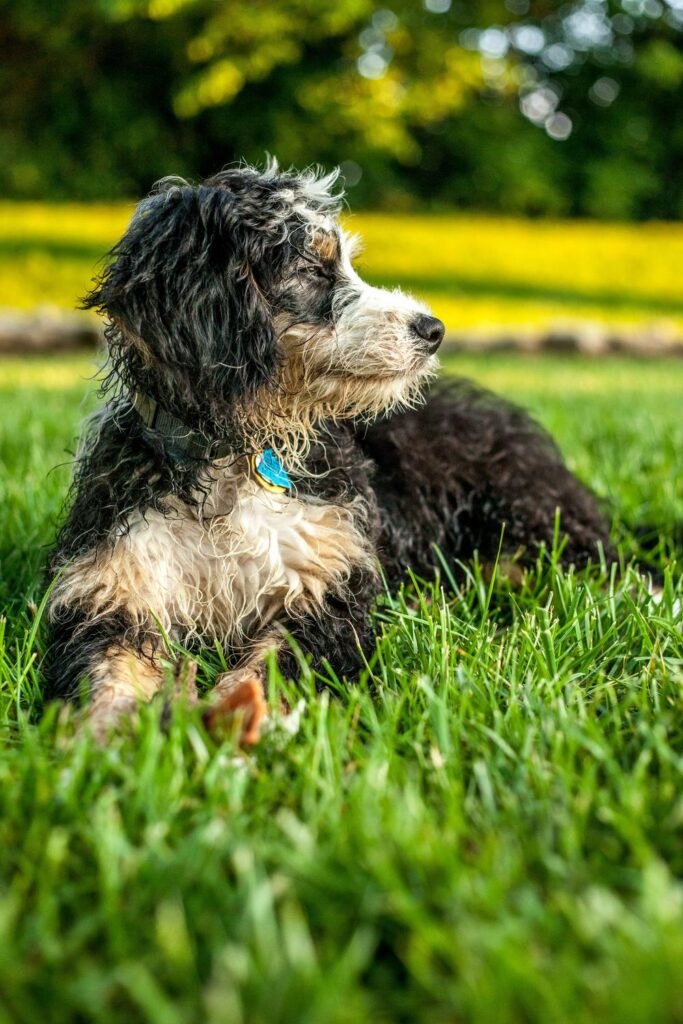
This is probably the biggest misconception about Bernedoodles.
People see: “Poodle mix = low shedding = easy coat.”
Not necessarily.
How often should you brush a Bernedoodle?
At minimum, plan on weekly brushing.
For dogs with long, curly or wavy coats, more frequent brushing may be necessary to prevent mats.
PetMD specifically describes Bernedoodles as requiring frequent brushing and professional grooming.
Depending on the coat, you may need:
- Slicker brushing
- Comb-throughs
- Regular professional grooming
- Ear cleaning
- Nail trimming
- Paw hair maintenance
Why does the coat mat so easily?
A curly Poodle-type coat can trap loose hair rather than allowing it to fall out.
That sounds great until you realize: the hair that doesn’t fall onto your floor can end up tangled against the hair that is still attached to your dog.
That’s why “low shedding” does not automatically mean “low maintenance.”
Do Bernedoodles need professional grooming?
Usually, yes.
How frequently depends on coat length and texture, but owners should budget for regular professional grooming.
If you want to keep the coat relatively long and fluffy, grooming becomes even more important. If you’re willing to keep the coat shorter, maintenance can become easier.
What about bathing?
Bernedoodles don’t need constant bathing.
PetMD recommends bathing when the dog is dirty and avoiding excessive bathing; its guidance suggests no more than about once a month unless there’s a specific reason.
6. Are Bernedoodles Hypoallergenic?
This deserves its own section because it is one of the biggest SEO questions around the breed.
No dog is truly 100% hypoallergenic.
Bernedoodles may shed less than Bernese Mountain Dogs, particularly when they inherit a more Poodle-like coat, but individual dogs vary.
Some Bernedoodles can shed considerably more than owners expect.
If someone in your household has significant dog allergies, don’t rely solely on the breed name or the breeder’s claim.
Spend time around the specific dog before making a commitment.
7. Common Bernedoodle Health Problems
Bernedoodles can inherit health risks associated with either parent breed.
Because Bernedoodles aren’t a standardized purebred with a uniform genetic profile, it is more useful to think about parent-breed health risks and individual breeding quality than to assume every Bernedoodle has the same disease profile.
Hip Dysplasia
Hip dysplasia is an important concern in Bernedoodles, particularly larger dogs.
It occurs when the hip joint develops abnormally, potentially leading to pain, instability, and arthritis.
PetMD identifies both hip and elbow dysplasia as important Bernedoodle health concerns.
Keeping your dog lean is particularly important because excess body weight increases stress on the joints.
Elbow Dysplasia
Elbow dysplasia is another orthopedic concern inherited from the parent breeds.
It can result in limping, pain, reduced activity, and arthritis.
This is one reason breeder health screening is much more important than simply choosing a puppy based on coat color.
Progressive Retinal Atrophy (PRA)
PRA is a group of inherited retinal diseases that can progressively impair vision and eventually cause blindness.
Poodle lines are associated with several inherited eye disorders, including PRA. OFA/ACVO documentation identifies PRA as a significant inherited retinal disorder in dogs, and Poodle eye-health information specifically includes PRA-prcd.
Allergies and Skin Problems
Bernedoodles can develop environmental allergies, food allergies, itching, skin infections, ear infections, and hair loss.
PetMD notes allergies among the health issues that can occur in Bernedoodles.
And the thick, curly coat can make skin problems harder to notice.
Regular grooming isn’t just cosmetic—it gives you an opportunity to actually inspect the skin.
Gastric Dilatation-Volvulus (Bloat)
Standard Bernedoodles may have an increased risk of GDV because of their large size and deep chest.
Signs can include:
- Restlessness
- Repeated unproductive retching
- Drooling
- Enlarged abdomen
- Difficulty settling
- A “praying” posture
GDV is an emergency. If these signs appear, don’t wait to see whether they improve. Immediate veterinary attention is required.
Degenerative Myelopathy
Degenerative myelopathy is a progressive neurological disease associated with certain genetic variants.
The Bernese Mountain Dog deserves particular attention here because OFA notes that Bernese Mountain Dogs can carry both the common DM1 variant and a Bernese-specific DM2 variant.
That makes genetic testing of breeding dogs especially relevant when evaluating Bernedoodle breeders.
Cancer and Bernese Mountain Dog Genetics
This is an uncomfortable topic, but it shouldn’t be ignored.
Bernese Mountain Dogs have a notably serious cancer burden, including histiocytic sarcoma.
That does not mean a Bernedoodle will develop cancer.
Nor does crossing a Bernese Mountain Dog with a Poodle magically eliminate inherited disease risk.
This is one of the reasons a breeder’s health records and family history matter.
8. What Health Testing Should a Bernedoodle Breeder Provide?
This is one of the most important sections for prospective owners.
Don’t accept: “Our dogs are healthy.”
Ask for actual documentation.
The Orthopedic Foundation for Animals (OFA) maintains health-testing records including hip and elbow evaluations, cardiac testing, eye examinations, patellar evaluations, and DNA-based tests.
For a Bernedoodle, you should pay particular attention to the health history of both parent breeds.
Useful areas to investigate for the Bernese Mountain Dog parent: hips, elbows, eyes, cardiac health, degenerative myelopathy testing, and relevant family history.
Useful areas to investigate for the Poodle parent: hips (where appropriate), eyes, patella, relevant DNA testing, and family history of inherited disorders.
The exact testing program can vary depending on the Poodle’s size and the breeding program.
A useful buyer rule: if a breeder won’t show you health-test documentation for the parents, don’t let the puppy’s cute face make the decision for you. The OFA also makes normal submitted health results publicly searchable, which can help buyers verify claims.
9. Who Is a Bernedoodle Best For?
A Bernedoodle may be a great fit if you:
- Want a highly social family dog
- Enjoy spending time with your dog
- Have time for daily walks
- Enjoy training
- Want an intelligent dog
- Like hiking or outdoor activities
- Don’t mind professional grooming expenses
- Can manage a large dog
- Have enough space for a Standard Bernedoodle
- Are comfortable with regular brushing
- Want a companion rather than an independent dog
Think twice if you:
- Want a truly hypoallergenic dog
- Don’t want to groom regularly
- Hate dog hair
- Work away from home all day
- Want a very independent dog
- Don’t have time for training
- Don’t want a large dog
- Have a very small living space and are considering a Standard
- Want a dog that requires little veterinary or grooming expense
10. The Biggest Bernedoodle Misconception
The biggest mistake prospective owners make is assuming:
“Bernedoodle = Bernese Mountain Dog personality + Poodle intelligence + hypoallergenic coat + no health problems.”
Real life is much messier.
You might get a very curly, low-shedding coat—or a wavier, shedding coat. A calm couch companion—or a highly energetic dog. An easygoing dog—or a stubborn one. A 25-pound Mini—or a 90-pound Standard.
That’s the trade-off with many designer crosses.
The Bernedoodle can be an excellent dog, but it isn’t a perfectly predictable product.
11. Bernedoodle FAQ
How big does a Bernedoodle get?
Standard Bernedoodles can weigh roughly 61–100 pounds and stand up to around 29 inches tall. Mini and Toy Bernedoodles are considerably smaller.
How long do Bernedoodles live?
PetMD gives approximate lifespans of 12–15 years for Standards, 14–16 years for Minis, and up to 18 years for Toys. Individual lifespan can vary considerably.
Are Bernedoodles good family dogs?
Yes. They are generally affectionate, playful, and social, and can be excellent family companions when properly socialized and trained.
Are Bernedoodles good with children?
They can be. Their generally gentle and social temperament can work well with families, but large Bernedoodles can accidentally knock over small children, so supervision and training are important.
Are Bernedoodles good with cats?
They can be. Early socialization and careful introductions are important, and individual temperament matters more than the breed label.
Are Bernedoodles easy to train?
Usually, they are quite trainable because of their Poodle heritage and intelligence. Positive reinforcement tends to work well.
Do Bernedoodles bark a lot?
They are not generally considered extremely vocal, but individual dogs can bark more depending on genetics, socialization, environment, and boredom.
Do Bernedoodles shed?
Some shed very little, while others shed noticeably more. Coat genetics vary substantially between individual Bernedoodles.
Are Bernedoodles hypoallergenic?
No dog is completely hypoallergenic. Some Bernedoodles may be better tolerated by certain allergy sufferers, particularly those with more Poodle-like coats, but there are no guarantees.
Do Bernedoodles need a lot of grooming?
Yes. Regular brushing and professional grooming are usually necessary, especially for curly or longer coats.
How often should you brush a Bernedoodle?
At least weekly is a reasonable baseline, but curly or long coats may require brushing several times per week to prevent mats.
How much exercise does a Bernedoodle need?
Most adult Bernedoodles benefit from daily walks plus play and mental stimulation. PetMD recommends at least two walks per day.
Are Bernedoodles good apartment dogs?
Mini and Toy Bernedoodles can adapt relatively well to apartment living if their exercise and mental needs are met. A Standard Bernedoodle is much more challenging simply because of its size.
Can Bernedoodles be left alone all day?
It isn’t ideal to routinely leave a Bernedoodle alone for an entire workday. Many are strongly people-oriented and need companionship and mental stimulation.
Are Bernedoodles high maintenance?
Yes, in some important ways. Their temperament may be relatively easygoing, but their coat, grooming, exercise, training, and potential veterinary costs can make them a fairly demanding dog.
Are Bernedoodles good for first-time dog owners?
They can be, but a Standard Bernedoodle isn’t necessarily an easy first dog. The combination of large size, grooming requirements, exercise, and training deserves serious consideration.
Are Bernedoodles expensive to maintain?
They can be. A large dog eats more, professional grooming can be expensive, and veterinary costs for a 70–100-pound dog can add up quickly.
Do Bernedoodles have health problems?
Yes. Potential concerns include hip and elbow dysplasia, PRA, allergies, GDV in larger dogs, and inherited conditions associated with the parent breeds.
Are Bernedoodles prone to bloat?
Standard Bernedoodles may be at risk of GDV because of their large size and deep chest. Learn the emergency signs before bringing one home.
Do Bernedoodles get separation anxiety?
Some can. Bernedoodles tend to be social and people-oriented, and their Bernese Mountain Dog ancestry is associated with dogs that may struggle with being left alone.
Are Bernedoodles good hiking dogs?
Many are excellent hiking companions once mature and physically conditioned. Their Poodle and Bernese Mountain Dog ancestry gives them the potential for good athletic ability.
Can Bernedoodles swim?
Many enjoy swimming, although individual dogs vary. Always introduce a dog to water safely and supervise swimming.
Can Bernedoodles live in hot weather?
They can live in warm climates, but heavy or dense coats can increase heat-management challenges. Exercise should be scheduled during cooler periods, and overheating should be taken seriously.
What is an F1 Bernedoodle?
An F1 Bernedoodle is approximately 50% Bernese Mountain Dog and 50% Poodle.
What is an F1b Bernedoodle?
An F1b is typically a Bernedoodle crossed back to a Poodle, making it approximately 75% Poodle and 25% Bernese Mountain Dog.
Is an F1b Bernedoodle better for allergies?
Not necessarily. F1b Bernedoodles may have a more Poodle-like coat and may shed less, but individual coat genetics vary and no Bernedoodle is guaranteed to be hypoallergenic.
What is the difference between a Bernedoodle and a Goldendoodle?
A Bernedoodle is a Bernese Mountain Dog × Poodle, while a Goldendoodle is a Golden Retriever × Poodle. Their appearance, temperament, size, and health considerations can differ.
Bernedoodle vs Goldendoodle: which is better?
Neither is universally better. Bernedoodles may appeal to people who want the Bernese Mountain Dog’s look and generally gentle personality, while Goldendoodles often have a more consistently outgoing retriever temperament. The individual dog and breeder matter enormously.
Is a Bernedoodle a good dog for seniors?
A Mini Bernedoodle may be manageable for some active seniors, but a Standard Bernedoodle can be physically demanding because of its size and strength.
Is a Bernedoodle a good dog for an active family?
Yes. Families who enjoy walking, hiking, training, swimming, and outdoor activities may find a Bernedoodle an excellent companion.
Is a Bernedoodle a good dog for someone who wants a low-maintenance pet?
Probably not. The coat alone can require substantial ongoing work.
Final Verdict: Should You Get a Bernedoodle?
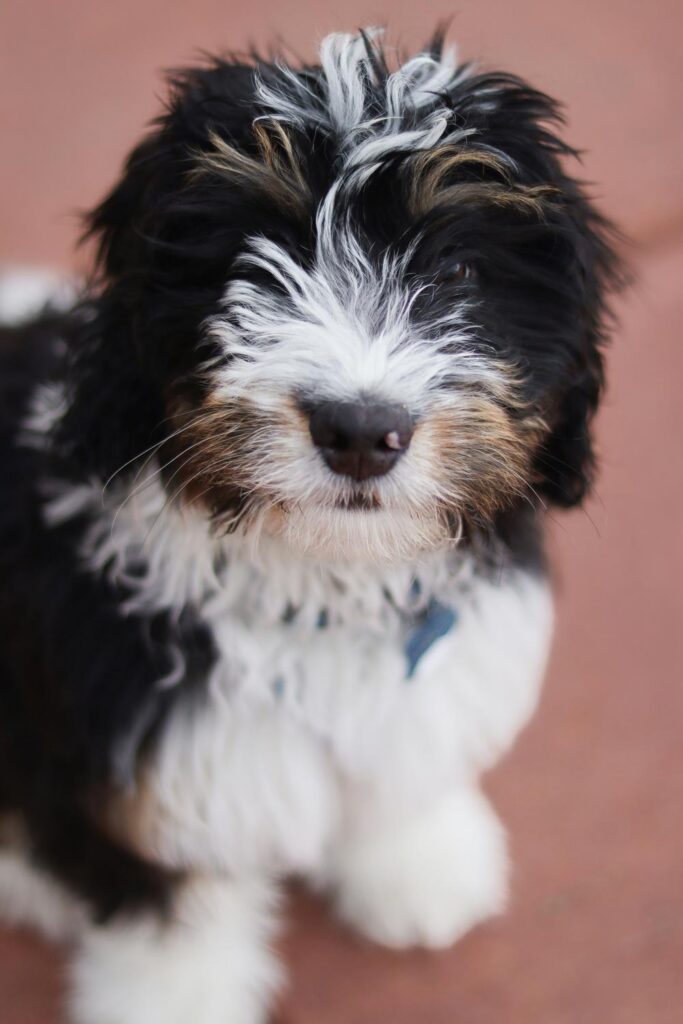
The Bernedoodle makes a lot of sense if what you want is a social, intelligent, affectionate family companion that can participate in your life.
But don’t buy one because you saw a fluffy tri-color puppy online and assumed it would be non-shedding, hypoallergenic, easygoing, healthy, and easy to train.
That’s the marketing version.
The real Bernedoodle is more complicated.
The best Bernedoodle owner is someone who enjoys having a dog involved in everyday life and is willing to invest in grooming, training, exercise, preventative care, and proper breeder research.
And if you’re considering a Standard Bernedoodle, remember one thing before you fall in love with the puppy:
That adorable 10-pound puppy may eventually become an 80–100-pound dog.
Plan for the adult dog, not the puppy.